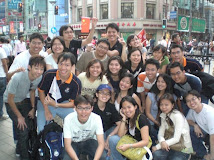
Being in one province of China is not adequate for one to say that they have seen China. This is one nation that captures the essence of heterogeneity within homogeneity. Every province shows different aspects of China, the historical, sociological, political, cultural, geographical etc. It is hard to embrace the grandeur of China in one visit because there is simply too much to see, to know and be a part of. This trip is of no exception but the span of two weeks enabled understanding to trickle bi-directionally between Singaporeans and the Chinese, igniting sparks of friendship (both internationally and intra-nationally) that can only strengthen with time. Here begins the magical feeling of connection, the appreciation of a different culture, and history.
With this trip, I must say that I’ve begun to appreciate and treasure the beauty of the Chinese language even more than before. I think the way the language has been used has given it a very soothing and melodious touch, such that it always sounds so polite. It’s really refreshing and fascinating to listen to the conversations of the Chinese! Some phrases in hanyu pin yin includes “Xin ku ni le”, a phrase that is used to show one’s appreciation for the hard work of another; “zhe4 bu4 hao3 ban4”, a phrase that is used when they want to let you know that something cannot be done, and even the simple “hao de, wo zhi dao le”, a phrase to inform you that one understands what has to be done. It’s also interesting to note the differences in the way Singaporeans end their questions as compared to some of the Chinese (I’m not sure if I can generalize this). An example of how Singaporeans may ask a question is “You want this hor” versus “Ni yao zhe ge shi ba”. That aside, there are so many different accents in China and it really takes time to get used to it. The profoundness of the language is something else and it is indeed a good time for us to be reconnected to our roots and a reminder to some of us that there is certainly plenty of room for improvement in our command of the Chinese language.
The Chinese has such a rich history and culture that it is certainly not hard to see why they are so proud of their nation. Such pride can only truly be understood if you are there to see it for yourself. And this is also coupled with the rapid changes that are taking place in China. From an outsider perspective, it’s really remarkable to witness how fast things change in so short a period of time. Then again, Singapore has also a very short history… Well, that aside, our Chinese friends are really warm and make really good hosts. It almost feels like they’d go all out to help you in anything and in anyway that is within their limits. They took time out to plan and anticipate where we would like to go, to bring us to the local places to try the local food, to care for the well-being of every student; it’s amazing. Is this what guanxi is all about?

The Journey Matters - Joshua Sim
An account of the 5th Sino-Singapore Undergraduate Exchange for NUS would not be complete without recounting the many stories on the way to everywhere.
Like all good stories, I think it started with a joke. Fun man's joke. And while it was extremely science-y and difficult to comprehend, it spiralled into a lot more. Impromptu Karaoke sessions, purple cider and bargaining stories are just a few more prominent ones in everyone's mind.
But I guess it wasnt what was said that made everything seem so strangely nostalgic now. Rather, somewhere between standing before everyone and singing 'wonderwall', I think everyone felt a certain sense of trust in our friendship. An understanding that it is alright even if we were off key just like it was alright even if Fun man's jokes weren't always understood. It was alright perhaps because we've learn to trust each other despite our short friendship.
My father once told me that in life, its always the journey that matters. In some ways I guess, this has been true for us on this trip to China. Anyone could have taken the same flight, visited the same places and seen the same sights. But it was only on the 5th Sino-Singapore Undergraduate Exchange, on the buses, planes and paths that we took, that truly made the journey memorable. Afterall, I guess It would be a long time till I'm able to sit beside one of the most soulful song writers on my generation or to scare someone with scary stories about planes from fight club or to steal small little flight pillows with.
Perhaps the exchange has ended, but I guess in a way, the journey never will.
'The Bund' by Joshua Sim
My room mate has an unhealthy obsession with the Bund in Shanghai. He wanted to go there to visit the sunset and sat around till it was late. It was easy for us to joke about his obsession until I was there myself. Perhaps now I have an unhealthy obsession with the Bund too.
The Bund felt oddly familiar. Before it reaches midnight, the Bund is bustling with businesses of every kind. Ice cream, coconuts and sausages were on sale almost everywhere. But when the night came and the crowd dispersed, the Bund became something else. It was to me, a symbol of aspiration.
As I gaze upon the skyline, the first thing that struck me was how the skyscrapers appear to reach out upon an impossible aim. To touch the sky. In its many lights, it almost looks as if some of the stars have been plucked from the sky in Shanghai's economic aspirations. The city portrayed its many achievements, its conquest over the night, height, distance and imagination. As the lights glittered rebelliously at the night, it was to me, a reflection of the city's desire to ever reach for the skies.
As I switch my attention to the people around me, it occured to me that such aspirations was not only symbolic, but also personal. Couples sat by the Bund perhaps making promises to each other, gazing upon the night sky. And my room mate too, walked around, with a sense of aspiration in his eyes.
As we snapped our last photos at the Bund, it seemed to me that the magical pull of the Bund is perhaps, our common desire, to reach for the very heavens. And it was this universal desire, that is so alluring, so beautiful.
'China: Three Cities, One Heart' by Tan Guowei
China is indeed a place rich in culture and history. From Beijing to Jinan, each city has its own cultural identity. Beijing, being the capital city of China for several dynasties, coupled with its fast pace of modernization, gives one the feeling of being in an ancient town within a modern city. On the second night of our stay in Beijing, six of us from NUS went out on a night run from the hotel to Tiananmen Square at 12 midnight. The night breeze that blew gently on our faces was cool and rejuvenating. On our way to Tiananmen Square, we were greeted with curious stares by the locals whom we approached to ask for the way to Tiananmen Square. The roads were still dotted with cars even at that hour. Uniformed policemen guarded the perimeters of the Square. It was as if we were running through the passage of time as the landscape transits between the modern and the ancient within the thirty-minute run.
What left me with a deep impression in Beijing is the trishaw ride from the gate of Beihai Gongyuan to Hutong. It was drizzling. Ruizhong and me got onto the trishaw belonging to this Shifu in his sixties (Shifu is a term used to address drivers in China). Once we got onto the trishaw, Shifu draped a cloth across our feet and said, “In case you get wet.” I looked up, realized that he is not wearing a rain coat like other trishaw riders and asked him, “What about you Shifu?” His reply was, “Not to worry, this rain will stop very soon.” At this moment, I felt embarrassed because as young men in our twenties, we were ferried around in the trishaw by this man in his sixties. Shifu, despite his age, was strong and ferried us around as fast as any other younger trishaw riders who ferried ladies who are much lighter than us. I am filled with respect for him.
Of course, our stay in Beijing is never complete without our friends from Peking University and Renmin University of China. Thanks to all of you for bringing us out for supper almost every night, despite that it is so near your examination period. The friendship forged in Singapore was further reinforced during our short stay in China. Selina, Wanqi, Chengkai and me had a really good chat with Zhang Hao and Yawen on our last night in Beijing at that small eating house along Ghost Street. That gathering was really memorable. Sixty of us tried to squeeze into the small room at 11pm, overwhelming the staff of the eating house.
Jinan, Shandong province, is the hometown of the renowned Chinese scholar, Confucius. As a Chinese Literature student back in my secondary school days, Jinan allowed me to relate to what I have learnt from the textbooks. We had a great dinner reception at Shandong University on 19th May and I made some great friends with the students from SICA. Thanks to everyone, NUS, NTU, SMU and Shandong University students and teachers for making my 24th birthday a most memorable one. It was very sweet for all of you to specially prepare a birthday cake for me.
Thanks to the Shandong University students who specially came down to our hotel to send us off.
Shanghai is a cosmopolitan city. I saw European tourists along the street and hear South Korean tourists chatting beside me as I walked in the shopping malls. With its high rise commercial buildings and comfortable subway trains, it is easy to mistake Shanghai for Singapore’s Shenton Way. Shanghai Jiaotong University had organized the most interesting activities for us. One of the highlights was to make dumplings, called “jiao zi” in Chinese. It is a Chinese tradition to make dumplings during the Chinese New Year as it symbolizes reunion, called “tuan yuan” in Chinese, which literally means “coming together in circles” since dumplings are round in shape.
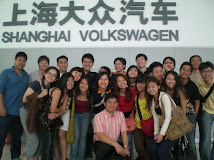
We had a good glimpse of the car manufacturing process at Shanghai Volkswagen. In anticipation of the F1 street circuit in Singapore in September this year, we were treated to the excitement of racing in the Shanghai F1 circuit.
Thanks to the Shanghai Jiaotong University students who came down to the restaurant and took bus with us all the way to the airport to send us off.
Let us not forget that many people are still mourning the deaths for their family members who died in the Sichuan earthquake. I pray that all of you will recover from the pain and emerge stronger. What struck me during this trip is that from the Beijing students who initiated fund raising efforts for the earthquake victims to the taxi driver who tune in to the radio for the latest reports on the earthquake to the youths in Shanghai rallying for the Beijing Olympics and the Sichuan earthquake victims, is that the Chinese are very united and passionate about their country. I really admire their love for their country.
To all our Chinese friends, I’m sure the friendship forged in the short 4 weeks that we spent together in Singapore and China will go a long way. We will see each other again!
Subscribe to:
Posts (Atom)